
Why Holmes Had To Exist
Policing in Victorian Times

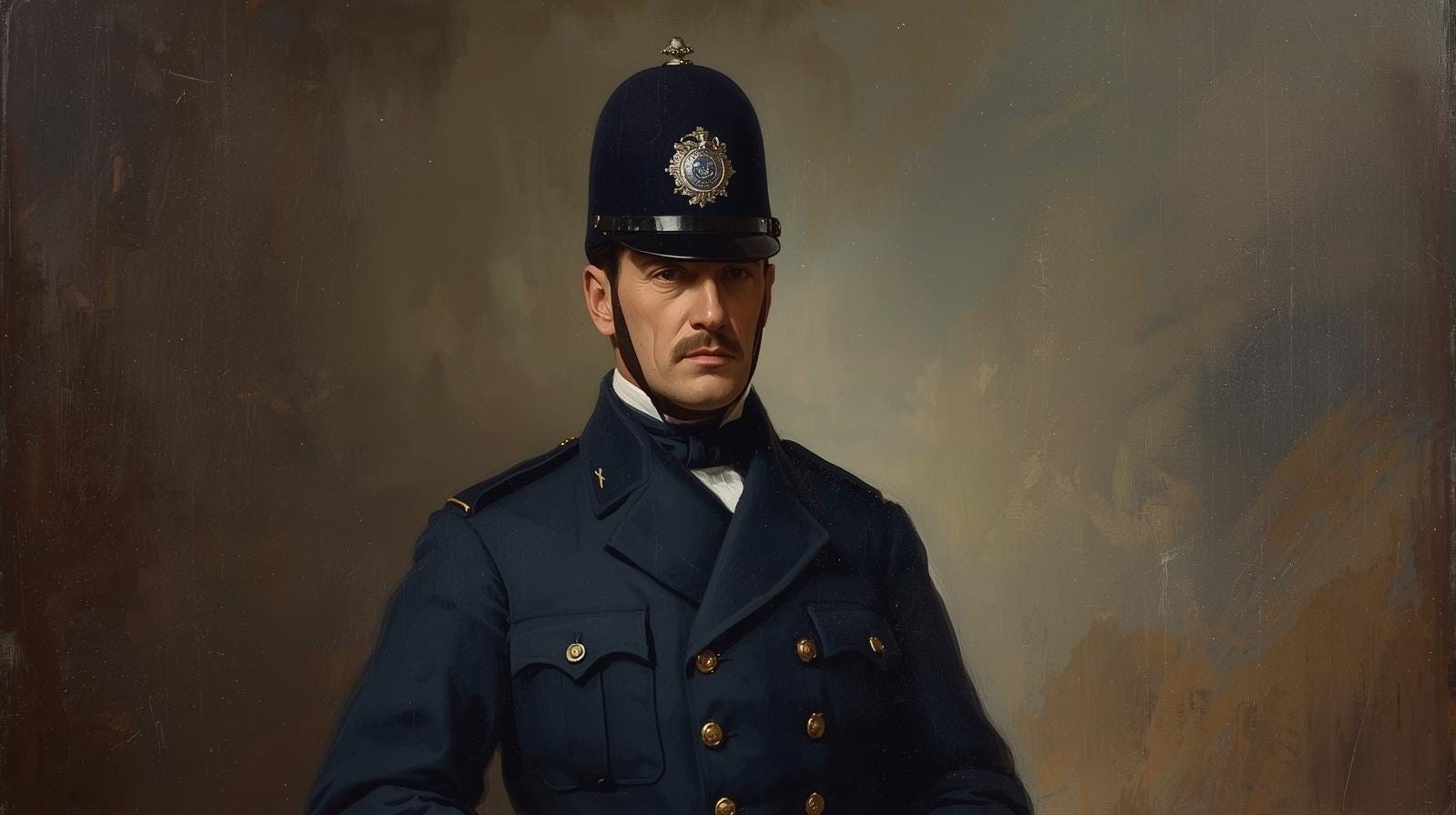
Sherlock Holmes feels inevitable now. Of course London needed its great detective; of course he stalked the foggy streets, out-thinking criminals and rescuing Scotland Yard from embarrassment. But when Arthur Conan Doyle first set pen to paper in the 1880s, Holmes wasn’t inevitable at all.
He was a response.
The truth is, Victorian policing was young, stretched thin, and often mistrusted. The Metropolitan Police had only been founded in 1829. By Doyle’s day, London had exploded in size, with millions crammed into its winding streets. The uniformed “Bobbies” brought a sense of order, but they were hardly an investigative force.
Detectives were newer still. The Detective Branch began in 1842 with a grand total of eight men. In 1878, it became the Criminal Investigation Department, but it was still a tiny, developing unit. Investigation in practice relied on confessions, witnesses, and luck, not science.
And the public knew it. The Jack the Ripper murders of 1888 made headlines around the world precisely because the police never caught him. Scandals such as the Turf Fraud case revealed corruption in the ranks. Journalists often portrayed detectives as bumblers. Doyle leaned into that perception when he gave us Lestrade and Gregson—competent, yes, but never quite up to Holmes’s brilliance.
Holmes filled the gap.
He was the detective readers wished they had; one who studied footprints, ash, and handwriting with scientific rigor. One who saw what others missed. One who brought certainty in a world where Scotland Yard often failed. Holmes was justice personified, unbought, uncorrupted, and utterly reliable.
That’s why he had to exist.
Holmes wasn’t just an invention of Doyle’s imagination, he was an answer to Victorian anxieties about crime, justice, and whether the men in blue could really be trusted. The Yard got better, of course, and modern policing owes much to pioneers Doyle could never have imagined. But in 1892, when you picked up a new Strand Magazine and saw Sidney Paget’s illustrations of the consulting detective at work, you knew you were about to experience something the real world rarely delivered.
You were about to watch justice done.
Andrew Peel
Andrew Peel is the author of Footsteps on the Moor a thoughtful reimagining of Sherlock Holmes time on Dartmoor via a private journal discovered by his brother Mycroft.